
If you drive a diesel truck, tractor or piece of heavy equipment built after 2010, you’ve probably noticed the blue-capped diesel exhaust fluid (DEF) fill port next to your diesel tank. DEF is the working fluid that your selective catalytic reduction (SCR) system uses to clean nitrogen oxide (NOx) emissions and keep your diesel running legally. Without DEF, your truck will force you into limp mode until you refill.
Understanding what DEF does, why it matters and how fluid quality affects performance can save you from costly repairs and frustrating downtime.
What Is DEF Fluid Made Of?
Diesel exhaust fluid is a mixture of 32.5% high-grade synthetic urea and 67.5% deionized water, standardized internationally under ISO 22241-1. Outside North America, it’s called AUS 32 (Aqueous Urea Solution 32%).
The urea in DEF is synthetic, not the biological kind. It’s produced from ammonia and carbon dioxide in a controlled industrial process, then mixed with deionized water to prevent mineral contamination. The purity matters. Trace metals, minerals or biological contaminants can poison the SCR catalyst, which is why you should never use agricultural-grade urea or tap water as a substitute.
Is DEF the Same Thing as AdBlue®?
Yes. AdBlue® is just the European brand name for the same ISO 22241-compliant urea solution. If you’re in the United States, you’ll see it called DEF. In Canada, you might see both terms. The chemistry is identical, meeting the same international standard.
Why 32.5% Specifically? The Eutectic Point Explained
That 32.5% ratio represents the eutectic composition, the exact mixture with the coldest temperature before freezing on the urea-water phase diagram (roughly 12°F / -11°C). Think of it like antifreeze. If you go above or below that ratio, the freezing point actually rises, along with the risk of one component separating out and crystallizing first.
That 32.5% ratio keeps DEF liquid across the widest temperature range. At the eutectic point, both components freeze simultaneously at the lowest possible temperature. At 30% or 35%, either the water or urea will freeze first, leaving you with slush or crystals in your tank. It’s chemistry doing the heavy lifting, so your SCR system doesn’t have to.
How DEF and the SCR System Actually Clean Exhaust Gas
What does DEF fluid do in practice? The selective catalytic reduction (SCR) system is an exhaust aftertreatment device that reduces NOx emissions. These are the brownish smog-forming pollutants that diesel engines produce when they burn fuel at high temperatures and pressures. The SCR catalyst sits downstream of the engine, and DEF is the chemical reagent that enables the reaction.
Step 1 — Injection and Evaporation in the Exhaust Stream
As hot exhaust gas exits the engine (typically 400° to 900°F), the DEF dosing module injects a fine spray of fluid into the exhaust flow. Heat from the exhaust instantly evaporates the water, leaving urea vapor behind. The dosing system is controlled by the engine’s computer, which calculates the exact amount of DEF needed based on engine load, exhaust temperature and NOx levels.
Step 2 — DEF Breaks Down Into Ammonia
The heat triggers a chemical reaction that converts urea, forming ammonia, which is then used to neutralize NOx in the catalyst.
Step 3 — Ammonia Reacts With NOx at the Catalyst
The SCR catalyst triggers the ammonia to react with NOx, converting toxic emissions into water and nitrogen. Modern diesel engines often include a Diesel Oxidation Catalyst (DOC) upstream to optimize this reaction.
Nitrogen Gas and Water Vapor Are the Final Result
The SCR process converts NOx into nitrogen gas and water vapor, two components that naturally exist in the atmosphere. Properly functioning SCR systems can reduce NOx emissions, turning these harmful pollutants into harmless byproducts.
Why Diesel Engines Are Required to Use DEF
Selective catalytic reduction (SCR) and diesel exhaust fluid (DEF) became standard across U.S. diesel engines following the Environmental Protection Agency’s 2010 heavy-duty highway diesel NOx emissions standards (40 CFR 86.007-11). NOx contributes to ground-level ozone (smog) and acidic precipitation, so the EPA set a limit of 0.2 grams per brake horsepower-hour.
This isn’t a manufacturer preference. It’s a legal emissions requirement. Similar standards apply to off-road diesel equipment under EPA Tier 4 Final regulations.
Which Vehicles Require DEF? (Model Years and Vehicle Types)
Most diesel engines built after model year 2010 require DEF to comply with EPA emissions standards. These include:
- Light-duty diesel trucks: Ram 2500/3500, Ford Super Duty, Chevy Silverado/GMC Sierra HD
- Medium- and heavy-duty trucks: Freightliner, Kenworth, Peterbilt, Volvo, Mack
- Agricultural equipment: John Deere, Case IH, New Holland tractors and combines
- Construction machinery: Excavators, dozers, loaders from Caterpillar, Komatsu, Volvo CE
- Industrial engines: Generators, pumps, compressors rated Tier 4 Final
If your diesel has a blue DEF cap, you need it. The blue color helps prevent misfueling.
Where Is the DEF Tank Located and How Do You Refill It?
DEF tank location varies by vehicle type and manufacturer, but finding and refilling it safely is straightforward once you know what to look for.
Finding Your DEF Tank (Typically Near the Diesel Fill or Under the Vehicle)
Most light-duty trucks place the DEF fill neck beside the fuel filler, marked with a blue cap. On heavy-duty trucks and equipment, it may be mounted under the frame rail, behind the cab or near the SCR system itself.
Light-duty trucks typically have 5- to 8-gallon tanks, while heavy-duty trucks may have 20+ gallon tanks.
How to Refill DEF Fluid Safely Without Contamination
Following the right steps prevents contamination that can damage your SCR system. Here’s how to refill DEF safely:
- Use only DEF-specific containers or pumps. Diesel fuel contamination will destroy the SCR catalyst.
- Don’t top off. DEF expands when it freezes, so leave room in the tank.
- Wipe the fill neck clean. Remove dirt before opening so debris doesn’t get inside.
- Use a DEF-specific funnel or jug spout. Avoid spills by using the correct accessories.
- Close the cap tightly. Seal the tank to prevent evaporation and contamination.
DEF is non-toxic and non-flammable, but it is mildly corrosive to some metals and will damage paint if left to dry. Rinse spills with water immediately.
What Happens If You Run Low or Out of DEF?
The EPA doesn’t take “maybe” for an answer. Federal regulations require manufacturers to install escalating driver inducements when DEF runs low, preventing tampering or system deletion. These aren’t suggestions; they’re countdown timers to forced compliance.
Warning Lights and Dashboard Alerts
Most systems give you plenty of warning before triggering derate mode:
- First warning (typically 1,500 to 2,500 miles of range remaining): Amber DEF warning light and message
- Second warning (typically 500 to 1,000 miles remaining): More urgent alert, possibly with audible chime
- Final warning (near-empty): Red warning light, countdown to derate
Some systems display exact mileage remaining until derate, while others show distance-to-empty in the DEF tank.
Why Derate and Limp Modes Are EPA-Mandated Safeguards
When the DEF tank runs empty, federal regulations require the engine to enter derate mode — a progressive speed or power limitation that varies by vehicle category and model year. Some engines limit speed to 5 mph, while others reduce power output significantly. In certain cases, the engine won’t restart once shut off. The severity and type of derate depend on the specific vehicle and EPA tier certification, but the outcome is the same — the vehicle becomes difficult to operate until you refill the DEF tank.
The inducement system is nonnegotiable and cannot legally be disabled or removed. Attempting to delete or bypass the SCR system is a federal violation that can result in thousands of dollars in fines for each tampering event for individuals and even higher penalties for commercial operators.
Comparing Standard vs. Premium DEF Fluid Quality
Not all diesel exhaust fluid delivers the same level of protection. While any ISO 22241-compliant DEF will keep you emissions-legal, quality differences can affect long-term SCR system health.
Risks of Low-Quality or Contaminated DEF
Standard DEF meets ISO 22241 and will keep your SCR system compliant, but not all DEF is created equal. Low-quality fluid can contain:
- Mineral contamination from improper storage or handling
- Biological growth from exposure to air and moisture over time
- Metal particles from corroded tanks or dispensing equipment
Over time, contamination can lead to crystallization in the dosing injector, clogged lines and SCR catalyst poisoning (all of which trigger fault codes P20EE, P20EF, P204F, P207F, P20E8, P218F) and costly repairs. Injector replacement alone can be costly, while catalyst replacement can be significantly more expensive.
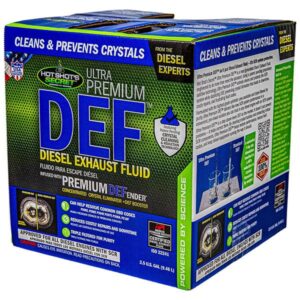
Introducing Hot Shot’s Secret Ultra Premium DEF
Hot Shot’s Secret Ultra Premium DEF delivers SCR system protection. Unlike standard or “premium” DEF products that only meet the minimum ISO 22241 standard, Ultra Premium DEF uses a proprietary additive technology that actively cleans and prevents crystal formation in the SCR system.
Ultra Premium DEF stands apart from standard products in several key ways:
- Triple-filtered purity: Ultra Premium DEF is formulated with the highest-grade synthetic urea available and triple-filtered to ensure maximum purity.
- Cleans existing deposits: The proprietary formula actively removes crystal buildup that restricts flow, triggers fault codes and reduces SCR efficiency.
- Prevents future crystallization: It stops new crystal formation before it starts, eliminating the downtime and costly repairs that follow.
- Protection: Ultra Premium DEF protects the entire SCR system, including the dosing injector and catalyst.
- API certified and compliant: It meets ISO 22241 standards and is API certified for use as a full DEF replacement in any diesel engine with an SCR system.
- Ready to use: The pre-mixed formula requires no dosing or mixing — just add it to your DEF tank and go.
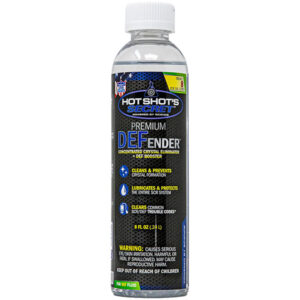
Ultra Premium DEF delivers the same performance benefits as Hot Shot’s Secret Premium DEFender, but with added convenience thanks to its ready-to-use formula.
Complete Diesel System Protection From Hot Shot’s Secret
While Ultra Premium DEF takes care of your SCR system, Hot Shot’s Secret offers solutions for the rest of your diesel engine:
- Fuel system protection: Diesel Extreme cleans fuel injectors, restores lost power and improves fuel economy by 2 to 5% when injectors are clean and atomizing fuel properly. LX4 Lubricity Extreme prevents injector wear in ultra-low-sulfur diesel.
- Oil system protection: Stiction Eliminator removes oil-thickening deposits that cause sticking oil injectors, rough idle, hard starts and power loss, especially in Ford 6.0L and 7.3L Power Stroke and other HEUI engines.
- Winter diesel protection: EDT+ Winter Defense is your everyday cold-weather additive, lowering the fuel’s gel point before freezing occurs. If your fuel is already gelled, Diesel Winter Rescue re-liquefies frozen fuel and filters for emergency treatment.
FAQs About Diesel Exhaust Fluid
Here are answers to the most common questions diesel owners have about DEF usage, safety and compatibility.
How much DEF does my truck use per mile or per tank of fuel?
Engine load, duty cycle and calibration all affect DEF consumption rates. Typical diesel engines consume approximately 2 to 3% of fuel volume as DEF. A diesel truck averaging 15 mpg will typically use about 1 gallon of DEF every 500 to 750 miles under mixed driving. Heavy loads, city driving and frequent idling increase DEF usage because the engine produces more NOx under those conditions.
Can I use DEF in any diesel vehicle or only certain models?
DEF is only used in diesel engines equipped with SCR aftertreatment systems. In the U.S., this category includes most diesel engines built after 2010 for on-road use and Tier 4 Final off-road engines. Older diesels without SCR do not use DEF and don’t have a fill port for it. If your diesel has a blue DEF cap, you need it. If not, you don’t.
Is DEF flammable, toxic or hazardous to handle?
No. DEF is non-flammable, non-explosive and non-toxic. It’s safe to handle without gloves, though it’s mildly alkaline and can irritate skin with prolonged contact. It will corrode some metals, like aluminum and copper, and damage paint if left to dry, so rinse spills with water.
DEF is safe to transport and store, but keep it sealed to prevent evaporation and contamination. Store DEF between 12°F and 86°F for optimal shelf life.
What happens if I accidentally put DEF in my diesel fuel tank?
Don’t attempt to start your engine. DEF in the fuel system will crystallize, clog fuel lines and injectors, and potentially damage the fuel pump and injection system.
If you catch it immediately, have the tank drained and the fuel system flushed before starting. If you’ve already started the engine, shut it off and call a diesel mechanic or mobile repair service. This is an expensive mistake that can require complete fuel system replacement, so prevention is worth the extra second to check the cap color. The blue DEF cap and clear labeling exist specifically to prevent this scenario.
Protect Your Diesel Investment With Ultra Premium DEF
Your diesel engine is a significant investment. Protecting its SCR system with high-quality DEF prevents costly repairs, reduces downtime and keeps your truck operating at maximum efficiency.
Hot Shot’s Secret Ultra Premium DEF actively cleans and protects your SCR system while meeting all industry standards. Contact us today to learn more about protecting your diesel engine with premium additives and fluids.