
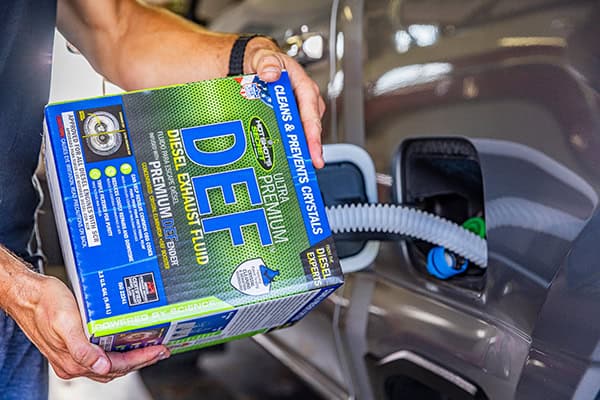
You may have heard that diesel exhaust fluid (DEF) can go bad sitting in the jug, or worse, you’ve already dealt with a fault code from contaminated fluid. Now you need the real answer, not the generic “keep it cool” advice, but the actual science of what wrecks diesel exhaust fluid and how to stop it.
DEF helps diesel engines meet EPA NOx emissions standards through the selective catalytic reduction (SCR) system. When your fluid degrades, you’re facing expensive SCR repairs and emissions failures. Here’s how long DEF actually lasts, why heat — not time — is the real enemy, how to verify your fluid is still good and exactly how to store it properly.
How Long Does DEF Actually Last?
Unopened DEF stored at an average room temperature (75°F) typically lasts 12 to 24 months. According to ISO 22241-3, shelf life is entirely temperature-dependent. A container stored at 50°F or below meets spec for up to three years, while one stored at 95°F lasts only six months before the chemistry breaks down.
DEF also degrades based on cumulative heat exposure. A jug at 100°F in your truck bed for a month degrades faster than one stored at 60°F in a garage for a year. If you’ve faced recurring DEF issues before, this temperature sensitivity may be why.
Why Heat Degrades DEF While Freezing Does Not
Above 86°F, the urea in DEF begins to break down prematurely via hydrolysis. Sustained heat triggers urea molecules to decompose into ammonia and other byproducts, which raise the fluid’s alkalinity. DEF has a urea concentration of 32.5% to prevent corrosion of SCR catalyst substrates and fouling of dosing injectors.
As alkalinity climbs and urea concentration drops, your DEF falls out of spec with no visible warning until you encounter SCR fault codes. Once urea breaks down into ammonia and degradation products, its chemical structure is permanently altered and does not revert upon cooling.
When DEF freezes, you’re dealing with a reversible change in physical state. DEF freezes at 12°F (-11°C) and expands by roughly 7%. Freezing causes water and urea crystals to separate, but once the fluid thaws, you can shake or mix the container thoroughly to recombine water and urea. Make sure containers have headspace for expansion to prevent cracking.
Storing DEF to Maximize Shelf Life and Prevent Degradation
The storage sweet spot for DEF is 12°F to 86°F per ISO 22241-3, out of direct sunlight in a sealed, contaminant-free container. If you’re storing DEF long-term, aim for 50-70°F. UV light accelerates urea breakdown, which is why DEF is sold in opaque containers made from high-density polyethylene (HDPE), polypropylene and stainless steel 316. HDPE tanks are most common because they’re affordable, chemically inert and UV-resistant.
DEF should never be stored in mild steel, aluminum, copper or galvanized containers, as urea reacts with those metals, causing contamination to the fluid and your SCR system.
How to Verify DEF Quality Before It Sidelines Your Equipment
The refractometer is the field standard for verifying DEF quality. It measures the refractive index, which is how much light bends as it passes through a liquid. For ISO 22241-compliant DEF, that index must fall between 1.3814 and 1.3843 at 68°F. If the reading falls outside that range, the urea concentration has drifted due to either water evaporation or DEF crystallization.
Visual cues that your DEF has gone bad include:
- Cloudiness: Fresh DEF is crystal-clear, so cloudiness indicates contamination or crystallization.
- White crystals: Solid material indicates the fluid has either frozen or degraded due to heat.
- Strong ammonia smell: DEF has a faint odor when fresh, but a sharp, pungent ammonia smell means hydrolysis is underway.
- Color change: DEF should be water-clear, so any yellow, brown or greenish tint indicates contamination.
Best Practices for Storing DEF in Any Environment
DEF absorbs moisture from the air and is vulnerable to contamination from dirt, diesel fuel, oil, metals and tap water. Always store DEF in sealed containers and recap jugs immediately after dispensing to keep out moisture and contaminants that accelerate degradation.
Keep DEF in its original container whenever possible because manufacturers use approved materials to prevent contamination. If you must transfer DEF, use dedicated DEF-only equipment. Never use containers that have held diesel, oil or coolant.
For bulk systems, use closed-loop transfer pumps with dedicated DEF-only nozzles to prevent cross-contamination, which ruins entire batches. If you’re managing intermediate bulk containers, use dedicated transfer equipment, install temperature monitoring and install vents to prevent pressure buildup.
Summer is harder on DEF than winter. A 100°F warehouse in July cuts shelf life to six months or less, while a 30°F garage in January just means you’ll thaw and mix your DEF before use. For winter DEF tank maintenance, remember that DEF expands about 7% when it freezes. Don’t fill containers to the brim — leave headspace for expansion.
Why Using Out-of-Spec DEF Means Expensive Repairs
Using degraded or contaminated DEF is a direct path to SCR system damage and costly repairs. Out-of-spec DEF either underdoses or overdoses your SCR catalyst. Underdosing leads to emission failures and check engine lights, while over-dosing causes crystal deposits, clogged injectors and corroded catalyst substrates. Either way, you’re looking at significant SCR system maintenance costs.
Don’t try to “fix” out-of-spec DEF by topping it off with fresh fluid. Instead, replace the batch entirely and dispose of contaminated DEF according to local regulations. Most municipalities accept DEF at hazardous waste sites or wastewater treatment facilities. If you have small quantities, such as a few gallons, of DEF to dispose of, consult EPA guidance. Larger quantities require proper hazardous waste disposal.
How Starting With Higher Purity DEF Extends Your Storage Window
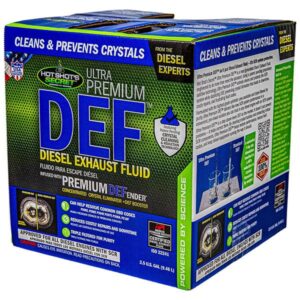
Hot Shot’s Secret Ultra Premium DEF™ is formulated with high-purity synthetic urea to maximize storage stability and is triple-filtered to remove contaminants and impurities. When a fluid starts with lower initial levels of biuret, aldehydes and trace metals, it has a larger margin before heat exposure pushes it out of spec, resulting in a longer viable shelf life. The fluid urea concentration is midrange at 32.5% and can afford to lose more urea to hydrolysis before falling below the minimum threshold.
Ultra Premium DEF is API-certified, ISO 22241-1-compliant and incorporates the same additive technology used in Premium DEFender to help prevent and dissolve crystal buildup in your SCR system.
FAQs About DEF Fluid Storage
For more questions, check our FAQ.
What happens to DEF quality in partially used containers?
Once you open a DEF container, the fluid is exposed to air and begins absorbing moisture, which accelerates degradation. Partially used containers have a shorter shelf life than unopened ones because every time you dispense, you introduce moisture and airborne contaminants. Use partially opened containers within six months if stored properly and always verify quality with a refractometer before use, especially if the container has been sitting for weeks.
Can I mix different DEF brands or batches?
Mixing different DEF brands is acceptable if ISO 22241 conforming, but it’s not ideal because you can’t know which batch will degrade first. The safer approach is to use one batch completely before starting another. If you must mix, verify the combined fluid with a refractometer test to ensure the blend still falls within the 1.3814-1.3843 refractive index range. Never mix fresh DEF with fluid you suspect might be degraded.
How should I label DEF storage to prevent contamination?
Clearly label all DEF storage containers, tanks and transfer equipment with “DEF ONLY” or “DIESEL EXHAUST FLUID ONLY” markings to prevent accidental cross-contamination. Use color-coded labels or tags — blue is common for DEF — and establish strict protocols that DEF equipment never touches any other fluid. For bulk tanks, post visible signage indicating contents, fill date and temperature monitoring requirements.
Protect Your Diesel Investment With Quality DEF Storage Practices
You now understand why heat permanently wrecks DEF through irreversible hydrolysis, how to verify fluid quality with refractometer testing and visual inspection, and how to store DEF to prevent degradation. The next step is choosing a DEF product designed for real-world storage conditions.
Ultra Premium DEF is powered by science and backed by the best money-back guarantee in the industry. If it doesn’t perform as promised, you get your money back. Starting with a cleaner, more stable fluid is the simplest way to protect your SCR system. Ready to make the switch? Place your order or reach out to our team.